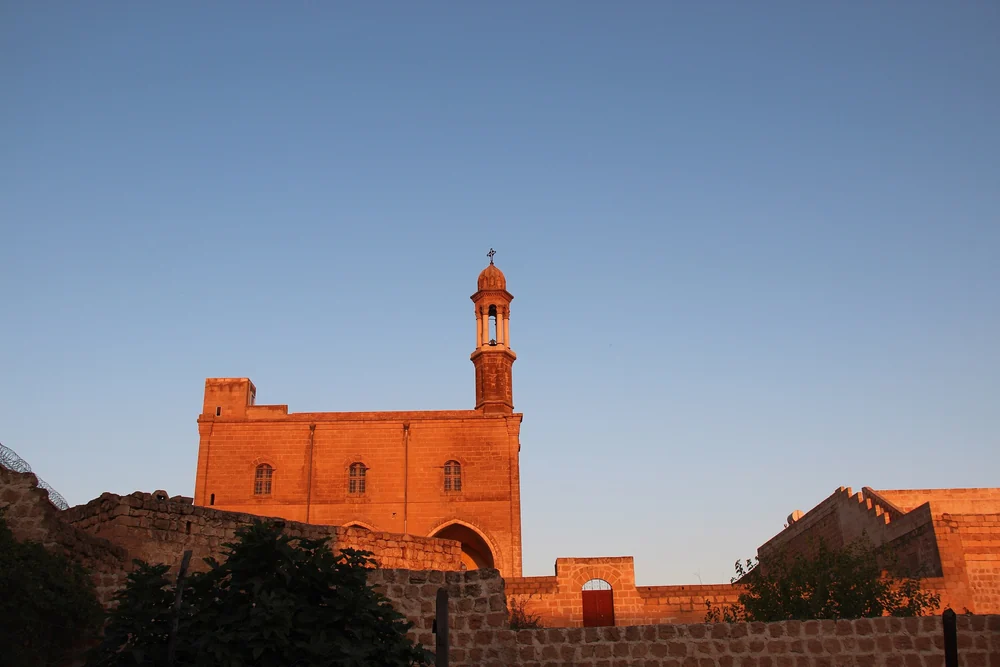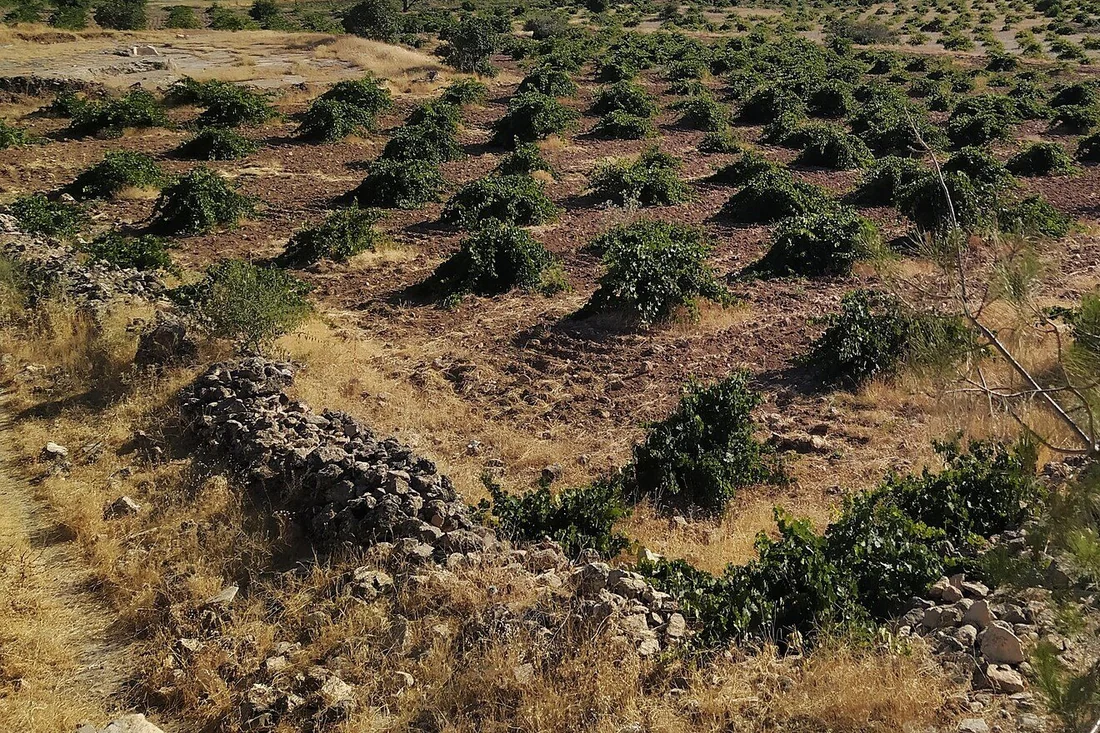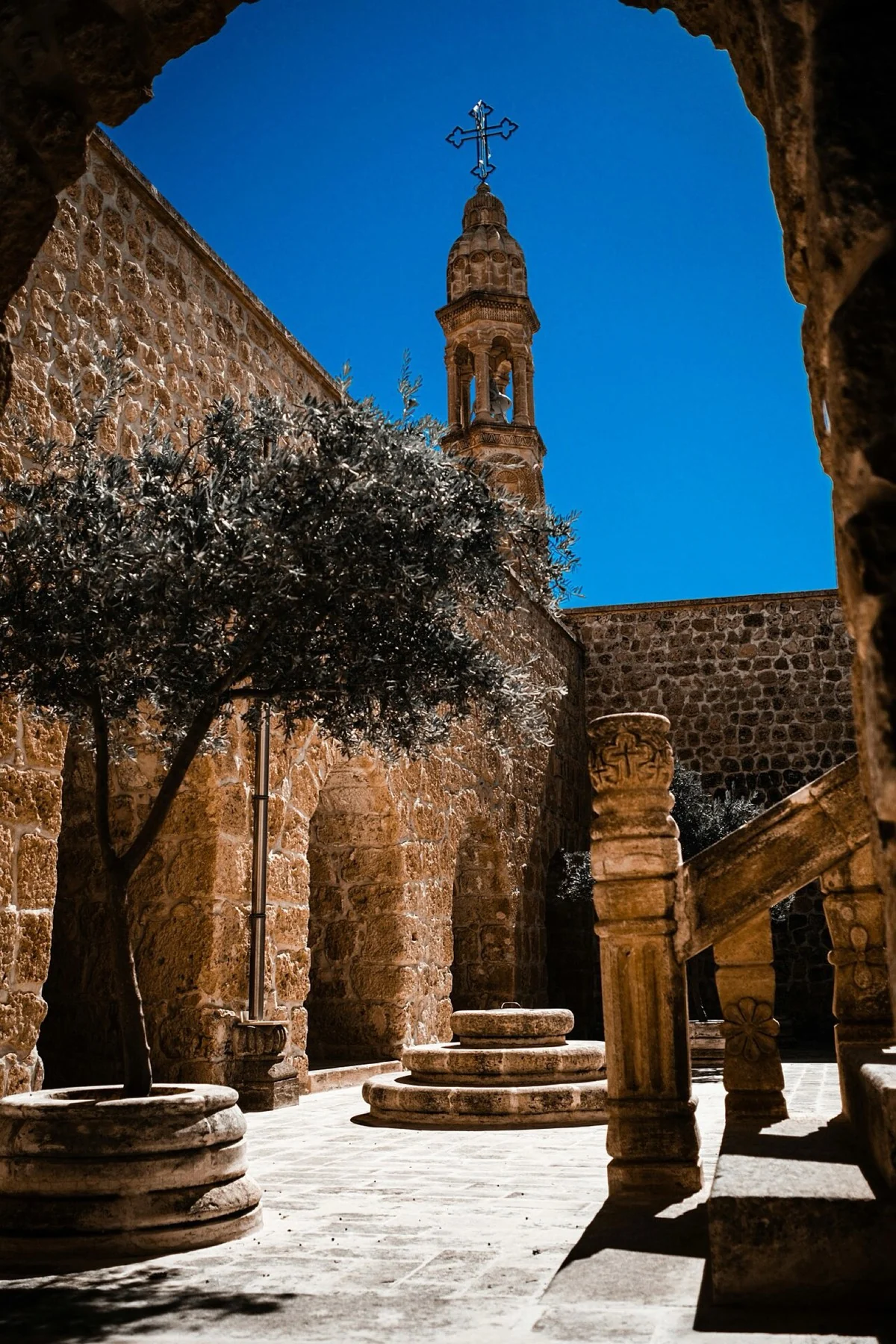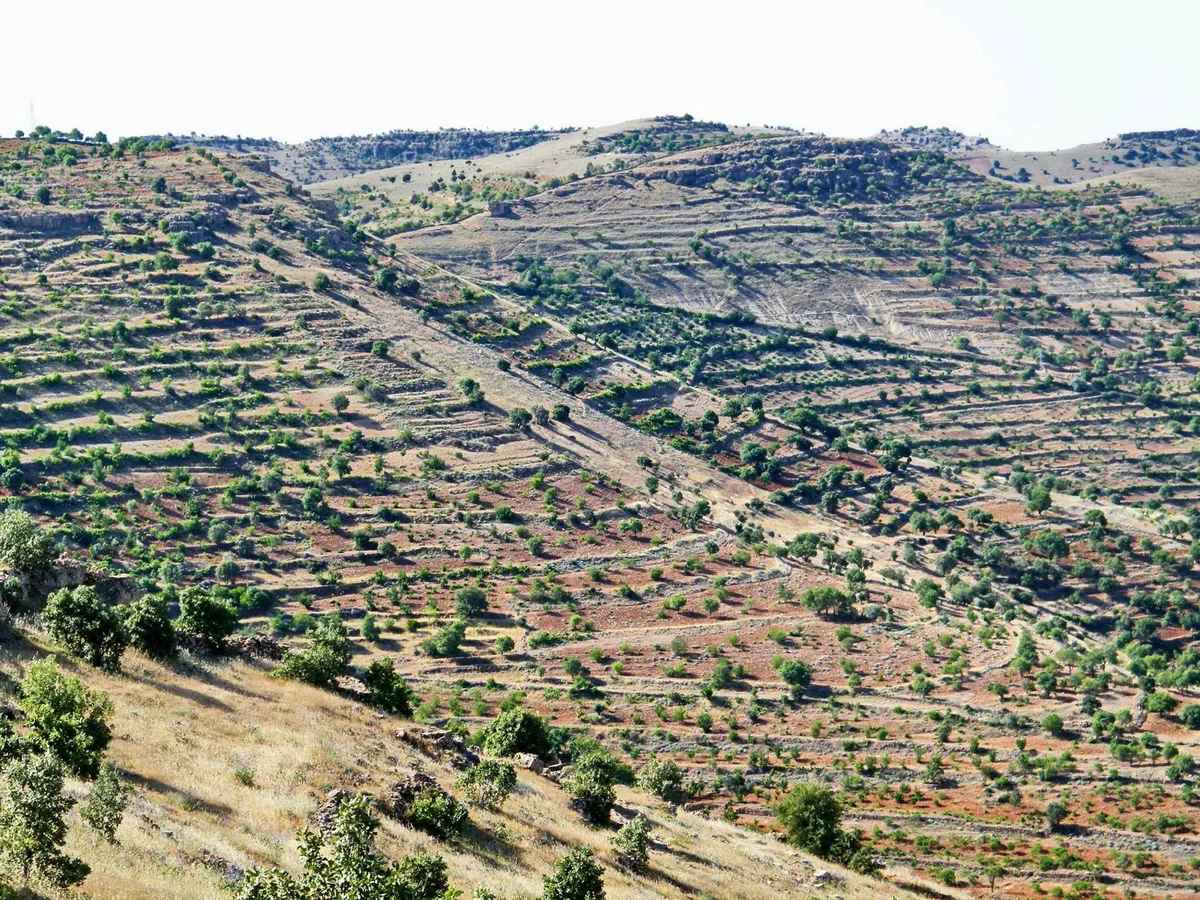
For centuries the Syriacs have called the limestone hills around Midyat Tur Abdin. The name means “mountain of the servants of God”, and it was the monks who settled these hills who gave it to the region. Today this plateau of some eighty villages holds nearly seventy monastery buildings and countless village churches. In some of them the liturgy is still celebrated every day; of others only the walls remain. In this article we describe, one by one, the monasteries and churches you can easily reach from Midyat, with their history, their architecture and their distance from Midyat.
- UNESCO Tentative List
- 2021
- Villages
- About 80
- Oldest buildings
- 6th century
- Distance from Midyat
- 10 to 72 km
Where is Tur Abdin?
Tur Abdin is a plateau bounded by the Tigris to the north and east, by the slopes that fall to the Mesopotamian plain to the south, and by the Mardin mountains to the west. Midyat is its centre, and the villages around Nusaybin, Savur, İdil and Hasankeyf are also counted as part of Tur Abdin. Christianity here goes back at least to the 4th century. According to Syriac sources, monks from the Mesopotamian plains settled in the hills in this period, living in caves and small cells, and over time monasteries grew up around these cells.
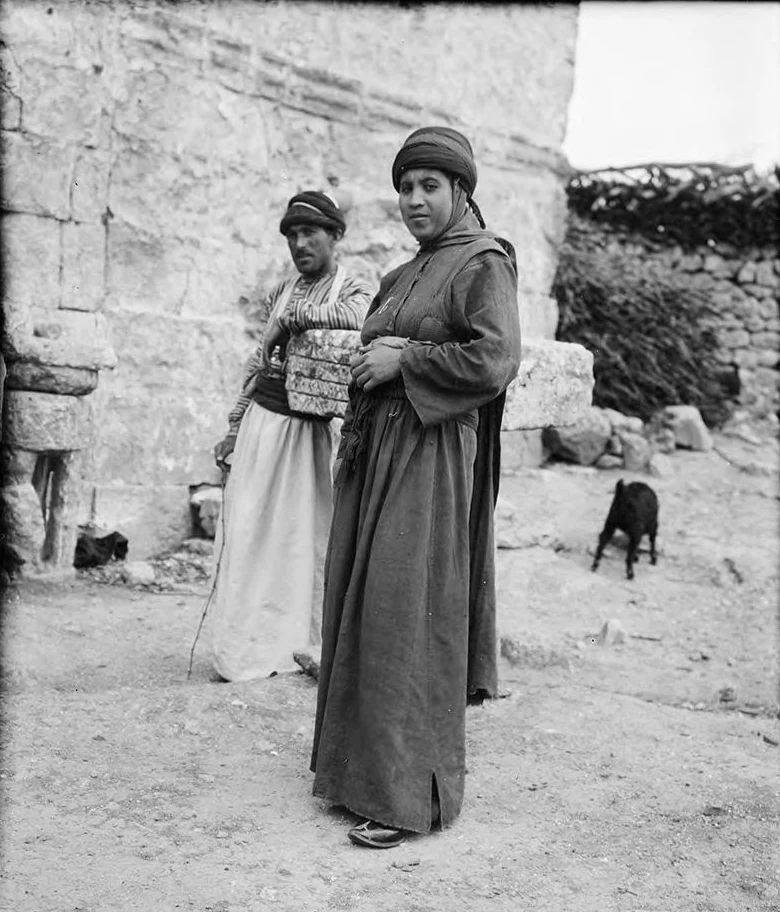
The people of the region belong to the Syriac Orthodox Church. Syriac is still used in the liturgy, while in the villages people speak Turoyo, a living dialect of Syriac. For centuries the monasteries were both places of worship and schools. Here monks copied manuscripts, taught students to read and write Syriac, and trained the clergy of the villages.
Tur Abdin on the UNESCO World Heritage Tentative List
In 2021 Turkey added the region to the UNESCO World Heritage Tentative List under the name “Late Antique and Medieval Churches and Monasteries of Midyat and Surrounding Area (Tur ʿAbdin)”. The list includes five monasteries and four churches. The monasteries are Deyrulzafaran (Mor Hananyo), Mor Gabriel, Mor Abay, Mor Loozor and Mor Yakup; the churches are Mor Sobo and the Virgin Mary in Anıtlı, Mor Kuryakos in Bağlarbaşı and Mor Azozoel in Altıntaş.
According to the UNESCO file, the 6th century monasteries of Tur Abdin are about four centuries older than the monasteries of Mount Athos in Greece. The file also points to the open air prayer places in the courtyards. Called beth slutho in Syriac, they are found nowhere else.
The architecture of the Tur Abdin churches
One of the first researchers to document these buildings in detail was the British archaeologist Gertrude Bell, who travelled through the region in 1909. Bell divided the churches by their plans into monastic churches and village churches. In the monastic churches the nave runs crosswise, so it is wider than it is deep. The main church of Mor Gabriel is the best known example of this type. Village churches are usually smaller, simpler buildings with a courtyard.
Almost all of them are built of the region’s yellow limestone. The walls are thick and the windows small, which keeps the interior cool in summer and warm in winter. Domes and vaults are built of stone. The carving around doors and windows is a much older example of the stonework you see on the houses of Midyat. The beth slutho in the courtyards consists of a wall with a niche facing east and an open space in front of it. In the summer months services were held here, in the open air.
Mor Gabriel Monastery (Deyrulumur, Qartmin)
About 23 kilometres from Midyat, Mor Gabriel is the best known monastery of Tur Abdin. It was founded in AD 397 by Mor Shmuel and his disciple Mor Shemun, and is known as the oldest surviving Syriac Orthodox monastery in the world. Older sources call it the Monastery of Qartmin, and locally it is also known as Deyrulumur. Its main church, built in 512, with its mosaics and dome, is among the most important buildings of the region. Today the monastery is the seat of the Metropolitan of Tur Abdin, and monks, nuns and students live here. We describe its history and visiting information in detail in our article on Mor Gabriel Monastery.
Mor Yakup Monastery (Mor Yakub, Salah, Barıştepe)
The village of Barıştepe, 11 kilometres from Midyat, is called Salah in Syriac. Its monastery is dedicated to a monk remembered as Mor Yakub Hbisho, “the Recluse”, who is believed to have died in 421. In the Syriac text telling his life the village appears as Shilloh. The monastery is thought to have been founded in the 5th century; the present church was built in the 6th century and renewed in the 8th.
The monastery is also where Daniel of Salah, a 6th century writer known for his commentary on the Psalms, was formed. From the late 13th century it was the seat of a bishop. It was abandoned in 1720 and reclaimed in 1851. Today, with its courtyard, guest house and church, it is a well kept monastery in use once again.
Mor Loozor Monastery (Mor Lazar, Habsenas, Mercimekli)
The village of Mercimekli, 10 kilometres from Midyat, is called Habsenas in Syriac. About 300 metres outside the village stands the Monastery of Mor Loozor, dedicated to Mor Lazarus, a 4th century bishop of Harran. The monastery is thought to have been refounded in the early 8th century by Mor Shem’un d’Zayte.
A stone tower about 7 metres high stands in the courtyard. It is a seclusion tower in which a monk lived for years in prayer without coming out, and it has a channel that carried water inside. This tradition is known to have continued in Tur Abdin into the 8th century, and this tower is the last surviving example in the region. The walls of the square monastery are 3 metres thick. Repaired in 1866, the building is now abandoned and in need of care.
Mor Kuryakos Church (Mor Quryaqos, Arnas, Bağlarbaşı)
The village of Bağlarbaşı, 14 kilometres from Midyat and called Arnas in Syriac, is home to one of the best preserved village churches of the region. The Church of Mor Kuryakos is thought to have been built in the late 7th century. An inscription on the stone screen separating the sanctuary shows that the church was standing by 761 at the latest. Its north wall and most of its vault were rebuilt in 1591 and 1592.
Mor Azozoel Church (Mor Izozoel, Kfarze, Altıntaş)
Altıntaş, 21 kilometres from Midyat and called Kfarze (Keferze) in Syriac, is a village with several old churches. The most important of them is the Church of Mor Azozoel. It is thought to have been built in the late 7th century. An inscription on the beth slutho in its courtyard proves that it existed by 934 at the latest. A record dated 1592 attributes its construction to the Byzantine emperor Anastasius I, but the historian Andrew Palmer, known for his extensive work on Tur Abdin, considers this record a later invention.
The church was damaged in 1416 and in 1855, and its vault was repaired in 1936. Besides Mor Azozoel, the village also has the churches of the Virgin Mary, Mor Yuhanon and Mor Abrohom.
Anıtlı (Hah): the churches of the Virgin Mary and Mor Sobo
The old name of the village of Anıtlı, 30 kilometres from Midyat, is Hah. Its Turkish name, meaning “with monuments”, reads almost like a nod to its old buildings. Hah is regarded as the first episcopal seat of Tur Abdin; in the early 7th century this role passed to Qartmin, today’s Mor Gabriel Monastery.
The Church of the Virgin Mary, in Syriac Yoldath Aloho (Mother of God), is one of the oldest and most beautiful churches of Tur Abdin. With its dome, the decoration that from outside looks like a two tiered crown, and its arches, it is among the most photographed buildings of the region’s architecture. Gertrude Bell was among the first researchers to photograph it, in 1909. According to a legend told in the village, the church was built by the Magi who came from the east.
The Church of Mor Sobo is a large building that may go back to the 5th century and later became the village’s episcopal church. Today it is in ruins. Inscriptions at the prayer place in its courtyard show that clergy were buried here between 1135 and 1295. The Monastery of the Cross outside the village was an episcopal seat from 1089 to 1873.
Mor Abay Monastery (Mor Abai, Qelleth, Dereiçi)
Dereiçi, 45 kilometres from Midyat, is a village in the district of Savur whose Syriac name is Qelleth. According to the sources, the Monastery of Mor Abay near the village was founded in 370 or in the 6th century. The monastery is now in ruins; on its walls you can see inscriptions from the period of the Artuqids, who ruled the region in the 12th century. The 8th century Church of Mor Yuhanon in the village was restored in 2006. Qelleth was an episcopal seat until 1730.
Deyrulzafaran Monastery (Mor Hananyo, the Saffron Monastery)
About 3 kilometres east of Mardin, Deyrulzafaran is 72 kilometres from Midyat and lies on the way for anyone visiting the two cities together. According to tradition the monastery was built on an ancient temple where the sun was worshipped; the stone roofed room on the lower floor is still shown as a remnant of this temple. The monastery was first dedicated to Mor Shlemun. In 793 it was restored by Mor Hananyo, bishop of Mardin, and came to be known by his name.
From 1166 to 1932 Deyrulzafaran was the seat of the Syriac Orthodox Patriarchate. In 1932 the patriarchate moved first to Homs and then to Damascus. Fifty three patriarchs and metropolitans are buried in the monastery. It has carried its name, meaning “saffron monastery”, since the 15th century. A popular story links the yellow colour of its walls to saffron mixed into the mortar. The monastery has the Domed Church and the Church of the Virgin Mary. Deyrulzafaran is still an active monastery today and the seat of the Metropolitan of Mardin.
Where to go on which day: a route from Midyat
It is not possible to see all of these monasteries and churches in a single day; to visit them without hurrying, we suggest setting aside two days.
Day one: Leave Midyat in the morning and stop at Mor Loozor in Mercimekli (10 km), then Mor Yakup in Barıştepe (11 km) and Mor Kuryakos in Bağlarbaşı (14 km). In the afternoon continue to Mor Gabriel Monastery (23 km) and end the day in Altıntaş (21 km).
Day two: You can see the churches of the Virgin Mary and Mor Sobo in Anıtlı (30 km) in the morning and drive on to Dereiçi (45 km) in the afternoon. Deyrulzafaran is best visited on your way to or from Mardin. For other places to see in Midyat, take a look at our guide to things to do in Midyat.
What to know before you visit
Mor Gabriel and Deyrulzafaran receive visitors regularly; since visiting hours can change with the season and religious holidays, we recommend checking before you set out. The doors of village churches are often locked. The key is usually kept by a family living in the village; asking someone in the village square is usually enough to have the door opened.
Most of these monasteries and churches are still used for worship. Wearing clothes that cover shoulders and knees, staying quiet during services and asking permission before photographing priests and villagers are the most natural forms of respect. In ruined buildings, not climbing the walls and not touching the stones helps this heritage pass to future generations. Some village roads are narrow and winding; take extra care, especially in winter and in rainy weather.
Sources: “Late Antique and Medieval Churches and Monasteries of Midyat and Surrounding Area (Tur ʿAbdin)”, UNESCO World Heritage Tentative List, 2021; Gertrude Bell, The Churches and Monasteries of the Tur Abdin; Andrew Palmer, Monk and Mason on the Tigris Frontier; Wikipedia articles on Tur Abdin, Mor Loʿozor Monastery, Anıtlı, Barıştepe, Bağlarbaşı, Altıntaş, Dereiçi and Mor Hananyo Monastery. Distances calculated with OpenStreetMap data.