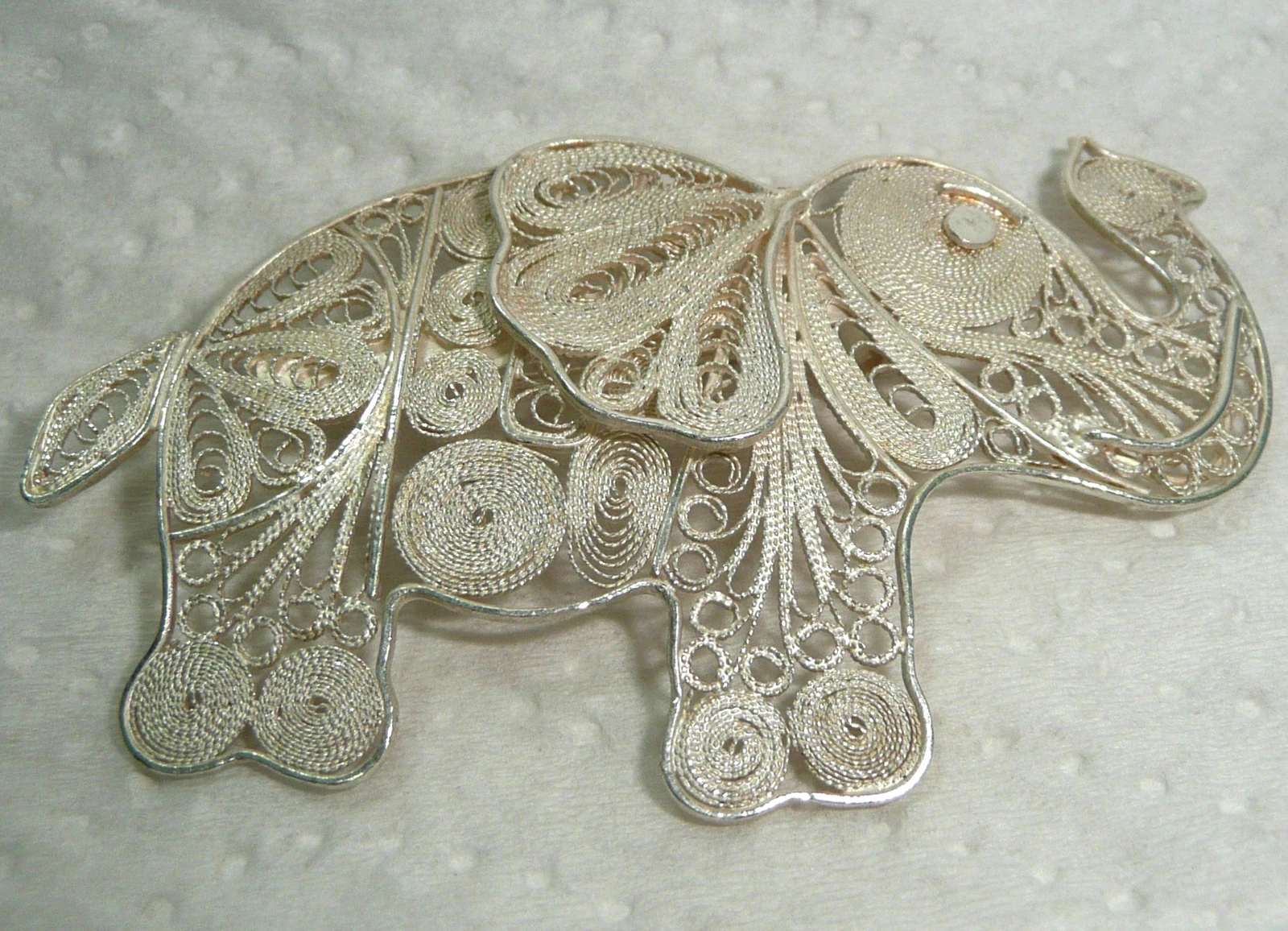
Walking past the small workshops of Midyat’s bazaar, you hear a faint tapping. Inside, a master bends over the workbench, curling silver wires as thin as a hair one by one with a tweezer-like tool and setting them in place. From a distance the result looks like lace; up close, like a tiny piece of architecture: telkari, silver filigree.
- Origin
- Mesopotamia
- Material
- Silver wire
- Apprenticeship
- At least 5–6 years
- Museum
- 2023, Midyat
Lace made of wire
As its name suggests, telkari is “wire work”. Melted silver is first drawn into fine wires, which are then bent, twisted and curled into a pattern. Light yet strong, letting light pass through from every side and showing no visible trace of soldering, this craft is known in many parts of the world, but in Midyat it has taken on an identity of its own.
The roots of the technique go back to the metalwork that began in Mesopotamia thousands of years ago. As the craft spread through Anatolia, one of its most important centres became Mardin, and within Mardin, Midyat. Today, “Midyat telkari” brings to mind patterns unique to the region and a mastery passed down over centuries.
The craft of Syriac masters
For a long time, telkari in Midyat lived in the hands of Syriac masters. Research notes that until the 1960s, almost only Syriacs practised telkari in and around Midyat. After that, Muslim craftsmen trained alongside Syriac masters also entered the profession, and telkari became a craft shared by Midyat’s different communities.
The skill is traditionally passed from father to son, or from master to apprentice. It takes at least five or six years before an apprentice can make telkari independently. In recent years the tradition has also taken on a new face: women masters have begun to train and to work in Midyat’s workshops.
A telkari master is trained in five or six years; a pattern, sometimes in a lifetime.
How is telkari made?
Making telkari takes patience and follows a series of steps:
Melting and drawing. The silver is melted, cast and passed again and again through a drawing machine until it becomes wire of the required fineness.
Twisting. The fine wires are twisted together in pairs to create a delicate braid that gives the pattern its texture.
The frame. The outline of the piece, its skeleton, is formed from thicker wire. A leaf, a bird or a geometric motif first appears as this frame.
Filling. The inside of the frame is filled piece by piece with curled fine wire, using a fine-tipped, tweezer-like tool the masters call the çift. This is the stage where the true mastery of telkari shows.
Soldering, cleaning and polishing. The parts are joined with heat, the excess is cleaned away and the silver is polished to its final finish.
Midyat hasırı
Another of Midyat’s best-known works is the weave known as “Midyat hasırı” (Midyat mat-weave). Made by weaving fine silver wire as densely and flexibly as a straw mat, this technique is used especially in bracelets and necklaces. The soft texture of the weave, together with the open, lace-like patterns of telkari, is considered the signature of Midyat’s silverwork.
The bazaar and the museum
The best way to see telkari in Midyat is to stroll through the bazaar where the silversmiths work and watch the masters at their benches. Many of them are happy to answer visitors’ questions.
The Telkari Museum, opened by Midyat Municipality on 10 December 2023, is the best place to see the craft all together. Located in the historic bazaar area of the Akçakaya neighbourhood, it is presented as Türkiye’s only museum dedicated to telkari. It displays historical pieces, and in a workshop section visitors can watch the making process up close.
Just as Midyat’s stone turns into lace in the hands of its masters, its silver is turned with the same patience into wire, and wire into pattern. Both are products of the same tradition: respect for the material and a skill handed down from generation to generation.
Sources: “Midyat Telkâri Ustaları” (research article); Mardin Telkari Museum, Küre Encyclopedia; Mardin Telkari Art, Edebiyat ve Sanat Akademisi; Midyat, Wikipedia.